Fellow Countrymen or Traps? The Deadly Cycle of Mutual Harm in Chinese Communities Around the World
This is not prejudice. It is a reality that countless people have learned through losses, financial ruin, and physical harm, a reality that is there for anyone willing to open their eyes: overseas, Chinese people often treat other Chinese people more ruthlessly, more maliciously, and in more unpredictable ways than outsiders do. From Southeast Asia to Europe and North America, from the streets of small countries to major international cities, kidnapping, fraud, financial exploitation, and even taking lives—the people who act most ruthlessly and show the least mercy are often their own countrymen hiding behind the identity of “fellow Chinese.” When outsiders exploit you, they do it openly. When your own people exploit you, they first greet you with a smile and then stab you in the back, leaving you with absolutely nothing.
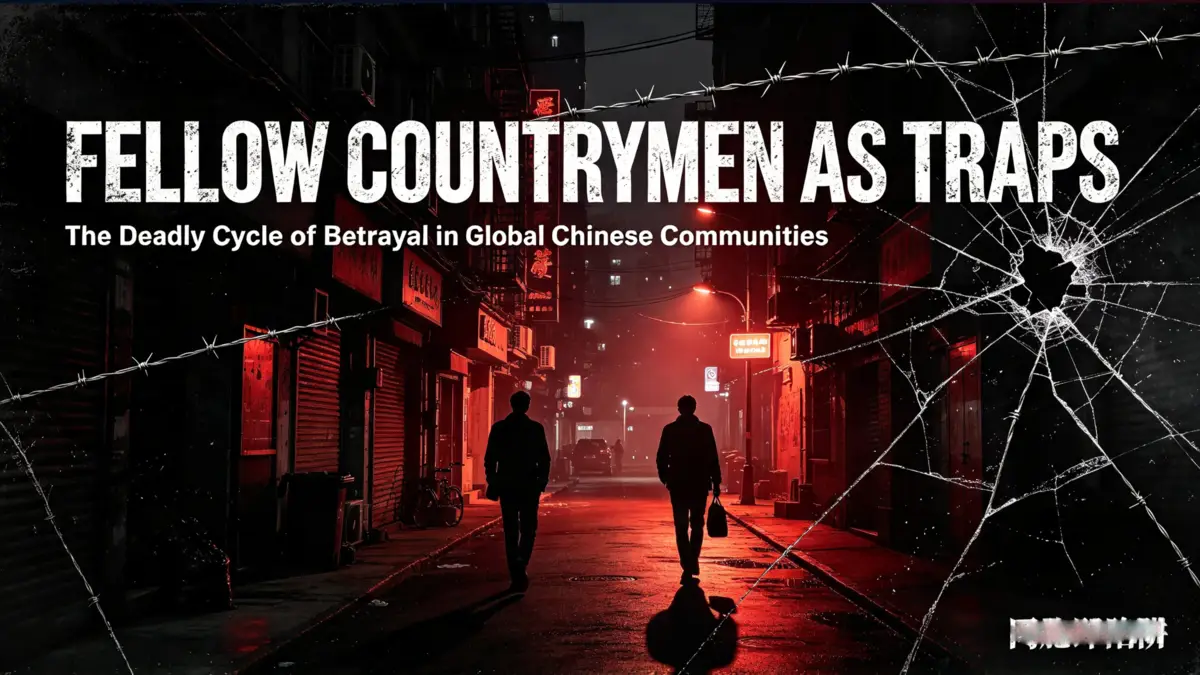
1. The Most Dangerous “Acquaintances”: First They Befriend You, Then They Strike
In places with large Chinese communities, such as the Philippines, Malaysia, and Indonesia, there is an unspoken understanding: the more eagerly someone approaches you and says, “We’re all one of our own” or “We Chinese don’t scam other Chinese,” the more tightly you should guard your wallet and the more carefully you should keep an escape route open.
Outsiders who want to scam you still have to beat around the bush and put on an act. When Chinese people scam other Chinese people, they do not even need much preparation. A few words like “fellow hometown resident,” “we come from the same place,” “we both came here from China,” or “we need to look out for each other while living abroad” are enough to lower your guard completely.
Just when you start feeling comfortable and treating the other person as one of your own, the scheme begins:
They claim to have a business that guarantees profits without any risk and invite you to join. Once they get your money, they immediately disappear.
They claim they can help you obtain legal status, find a job, exchange money, or get through border checks. Once they collect your money, they turn their backs on you and deny everything. Some may even turn around and sell you to an even more ruthless operation.
When you are in trouble, short of money, desperate to get something done, or left with nowhere else to turn, they voluntarily offer to “help.” They are so enthusiastic that they seem like your own brothers and sisters. But once you trust them and begin relying on them, you discover that you have fallen into a trap that was carefully laid long ago. What they want is your money, your freedom, and even your life.
In many parts of Southeast Asia, information used in kidnappings and extortion targeting Chinese people often comes from within Chinese communities. Those who deceive fellow countrymen, acquaintances, and even relatives into going to scam compounds or getting into vehicles are often the very people who used to call them brothers and act like close friends.
Outsiders do not know where you live, where you hide your money, who is in your family, or when you will return to China. The people who know your background best, understand your weaknesses most clearly, and can most accurately judge when you have let your guard down are often the fellow countrymen right beside you.

2. Scams Know No Borders: The Same Script Everywhere, Targeting Their Own People
Do not think this is just a problem in Southeast Asia. This network extends across the entire world.
Telecommunications fraud, cryptocurrency scams, investment schemes, and currency exchange scams primarily target Chinese communities. The language is familiar, the information is shared, and the cost of establishing trust is low. A fabricated story about something happening back in China or the mention of a hometown name can persuade countless people to lower their guard.
Fake job offers, illegal immigration traps, debt schemes, and identity-based extortion also take place in Europe, North America, and Australia. The people organizing these schemes, passing along messages, and drawing others into them are often “long-established Chinese residents” who have already been living locally for several years.
Even in places where rules and regulations are taken seriously, the people who exploit you most ruthlessly may still be acquaintances using the banner of “fellow countrymen.” They may abscond with business funds, misappropriate assets they were entrusted to hold, set traps by concealing information, or push you forward to take the blame when something goes wrong.
When outsiders deceive you, there may at least be laws and a shared social understanding through which you can seek justice. When Chinese people scam other Chinese people, they often operate in gray areas. You may not understand local laws, may struggle to explain what happened, may fear embarrassment or retaliation, or may even worry about being ostracized by both sides. In the end, you can only swallow your losses in silence.
They count on you not making a scene, not daring to report them, and having nobody to turn to for help. They count on the relationship between “fellow countrymen” being the safest possible disguise.

3. Why Target Their Own People? Because They Are Easier to Fool, Easier to Control, and Less Likely to Escape
This is not a coincidence. It is a calculated choice.
1. The Lowest Cost of Gaining Trust and the Weakest Defenses
When dealing with foreigners, you are naturally cautious. You investigate what they say and do, check their backgrounds, ask questions, and verify information.
But when dealing with another Chinese person, a single sentence like “We’re from the same hometown” can bypass all the safeguards that should have been in place.
You think, “We’re both Chinese. Surely they wouldn’t harm me.”
Precisely that belief that they “wouldn’t go that far” becomes the most fatal vulnerability.
The trust that might take outsiders months to establish can be obtained by a fellow countryman in just a few sentences. The ruthless things an outsider might find difficult to do can be done by a fellow countryman with a smile.
2. Information Asymmetry: They Know You Have Nowhere to Verify the Facts
Many people have only recently moved abroad or entered a new environment. They are unfamiliar with the language, do not understand the rules, and have no local connections.
At that moment, when a fellow countryman who claims to know the ropes appears, they seem like a lifeline.
You believe whatever they say. The price they quote becomes the price. The rules they describe become the rules. You have no way to verify the information and nowhere to ask whether it is true.
They tell you, “Everyone does things this way here,” or “Foreigners will all take advantage of you. I’m the only one helping you.”
You feel you have no choice but to trust them.
By the time you understand what has happened, your money is gone, your plans have fallen apart, and you are already under their control.
3. Closed Communities: You Cannot Easily Leave or Avoid Them
Chinese communities can be relatively small, where people constantly run into one another.
After someone exploits you, you may not dare to speak out. You fear being excluded by the community, damaging your reputation, being falsely accused by the other person, or finding that nobody else will be willing to deal with you in the future.
Even worse, the person who exploited you may spread lies about you throughout the community first. You become the one labeled “unreliable,” “someone who spreads rumors,” or “someone who repays kindness with hostility,” while they continue smiling and scamming the next person.
Someone who has cheated ten people may still remain part of the community as long as they have thick skin and know how to talk.
Someone who has been cheated once may end up isolated by the entire community if they dare to confront the person openly.
This is why so many people suffer enormous injustice but ultimately have no choice except to endure it in silence. If they endure it, they can still remain in the community. If they speak out, they may be the first to be excluded.
4. When Interests Are at Stake, Fellow-Countryman Ties Become the First Thing to Exploit
In the minds of many people, the words “Chinese people” are not a moral obligation. They are a resource that can be repeatedly exploited for personal gain.
When they need you, they call you “family.”
When they want you to contribute money or effort, they say, “If we don’t help our own people, who will?”
But once you are no longer useful, run out of money, or get into trouble, these same people are the quickest to run away, the fastest to distance themselves, and sometimes even the first to kick you when you are down.
Personal bonds are not a moral boundary. They are a tool.
Trust is not a sign of sincerity. It is a signal that the prey has entered the trap.

4. A Vicious Cycle: Every Victim May Become the Next Perpetrator
The most heartbreaking thing is that many people who have been exploited do not leave, do not warn others, and do not become more vigilant. Instead, they learn the same tricks themselves.
They have been deceived by fellow countrymen, so they know exactly where people are most likely to let their guard down.
They have been betrayed by acquaintances, so they know which words are most convincing.
They have fallen into traps set by others, so they learn to use the same traps against newcomers.
They tell themselves: If I do not exploit others, others will exploit me. If I do not strike first, I will be the one who suffers.
It is not that I am malicious. It is that the world has forced me to be this way. Everyone does the same thing.
And so the tricks are passed down, the distrust is passed down, and the suspicion of one another is passed down.
Generation after generation, newcomers arrive with hope and end up getting hurt. Once they have been hurt deeply enough, they either become equally cold and ruthless or silently seal their hearts shut.
Eventually, there is no sincerity left in the entire community, only calculation and suspicion. Nobody is truly trustworthy; the only question is who is better at pretending.
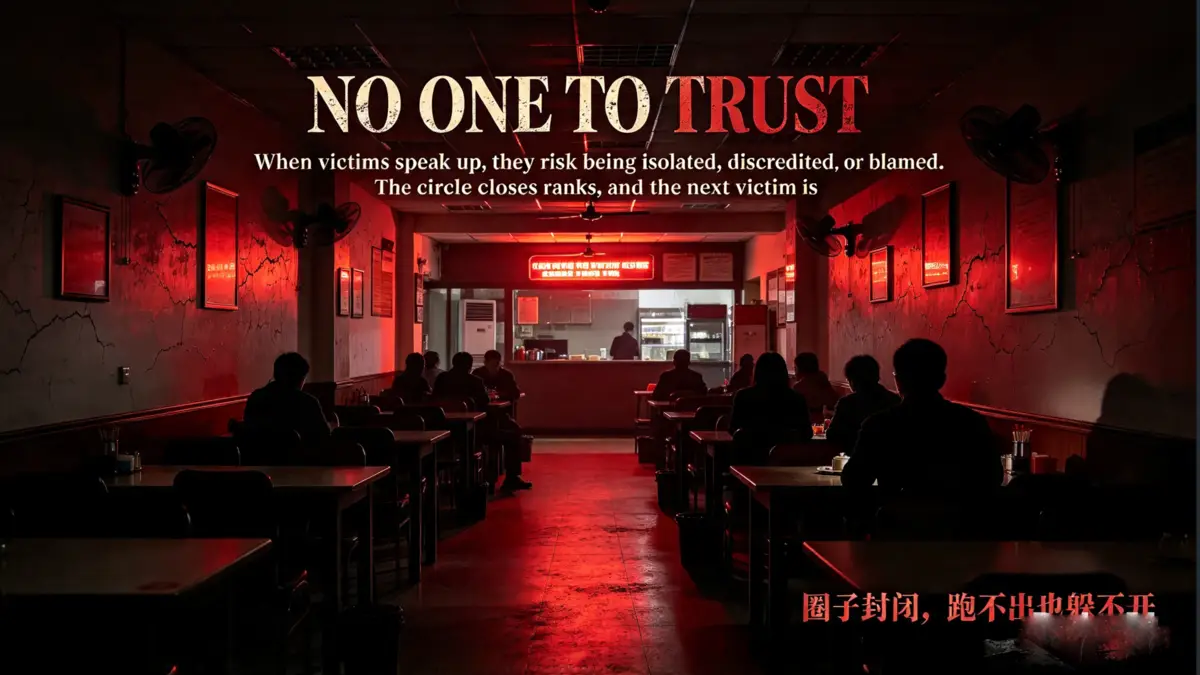
5. Stop Deceiving Yourself: “Shared Blood” Cannot Hide the Coldness Beneath
Some people will say that there are good people too, people who genuinely want to help.
That is true. They exist. But there are so few of them that their actions become news stories, legends, and comforting ideas people cling to for reassurance, rather than something that can be expected as the norm.
The norm is this: when you ask for help, you first consider whether you might become a target. When you place your trust in someone, you prepare yourself for betrayal. When someone shows you excessive enthusiasm, you first wonder what they want from you.
This is not the fault of one particular person. It is a deadlock accumulated by groups of people over generations.
You guard against me, and I guard against you.
You exploit me, and I exploit you.
If you do not treat me sincerely, why should I treat you sincerely?
After this cycle continues for long enough, nobody can clearly explain who first broke the rules. Everyone only knows that living this way seems to have become a necessity.
Even more tragically, in the eyes of outsiders, all of you look the same.
But only you know what lies beneath those similar faces. There is no warmth from people standing together and supporting one another, only the coldness of mutual suspicion. There is no closeness born of shared roots, only the indifference of people trying to figure out who can see through whom first.

6. One Final Word of Practical Advice
When living abroad, remember three things:
“ We’re both Chinese” is not a protective charm. More often than not, it is a warning signal.
Do not eagerly seek familiarity with strangers, do not casually reveal your personal details, and do not entrust your entire livelihood to someone simply because they call you “one of our own.”
Genuine kindness never needs to rush into establishing a relationship with you, declaring loyalty, or demanding that you open your heart and reveal everything about yourself.
Do not expect others to help you simply because they are supposed to. Do not hand over your trust for someone else to exploit. And do not become the kind of person who hurt you just because you have been hurt yourself.
This is difficult, but it is the only way to break this vicious cycle.

Explore More
› GraalVM Native Image: Advantages, Disadvantages and Real-World Experience
› How To Install Linux Properly: A Real-World Guide for Maximum Performance
› How to Optimize IBus Chinese Input on Linux: A Practical Configuration Guide